Stop Doing “Moderate” Exercise: New Research Argues for a Personalized, Vigorous Approach for Women Over 50
08/08/2026 / By Petra Stone

New research challenges standard moderate-exercise guidelines for women in midlife, suggesting that vigorous intensity — relative to an individual’s fitness level — is more strongly linked to cardiovascular health than universally defined moderate activity. A study published in Frontiers in Sports and Active Living examined 73 healthy women between the ages of 50 and 65, according to a report published by mindbodygreen on July 19, 2026. The findings indicate that relying on standard “moderate” thresholds may lead many women to overestimate the intensity needed to improve cardiorespiratory fitness.
Separate research has consistently shown that regular physical activity reduces mortality risk. A study published in PLOS Medicine tracked more than 11,000 Australian women over 15 years and found that those who met exercise guidelines in their 50s and 60s cut their risk of premature death by roughly half, according to a report by NaturalNews.com [1]. This backdrop underscores why correctly calibrating exercise intensity matters for long-term health.
Study Methodology and Results
Researchers recruited 73 women ages 50 to 65, including 38 recreational runners and 35 inactive women, to capture a range of fitness levels, the mindbodygreen article stated. Each participant completed a maximal fitness test to measure VO?max, the gold-standard indicator of cardiorespiratory fitness, and wore an accelerometer for seven consecutive days to objectively record daily physical activity. The investigators then compared activity patterns using both absolute intensity — standard metabolic equivalent thresholds — and relative intensity, which classified exertion based on each woman’s individual VO?max.
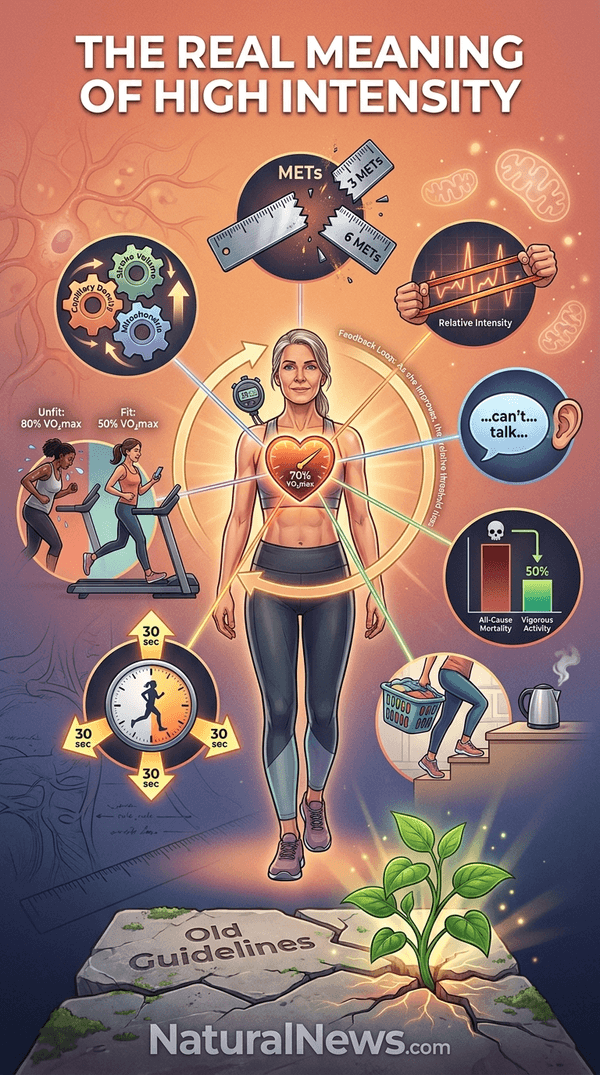
The results showed a stark divide. The recreational runners, who had higher cardiorespiratory fitness, averaged about 20 minutes of vigorous activity per day. The inactive women averaged less than one minute. When researchers analyzed the association between exercise intensity and fitness, they found that relative intensity explained 70% of the variation in cardiorespiratory fitness, compared to 53% for absolute thresholds, the report noted. This suggests that standardized guidelines may not accurately capture the effort needed to drive cardiovascular adaptation in midlife women. According to the book “Running for Women” by Jason Karp, muscle responds to vigorous strength training and “can achieve marked and rapid improvement even in the ninth decade of life” [2], reinforcing the principle that intensity relative to individual capacity is key.
Why Standard Guidelines May Fall Short
The standard moderate-exercise threshold used in many physical activity guidelines was designed for a general population and does not account for individual differences in fitness, the mindbodygreen article stated. The researchers described an “intensity paradox”: a less fit woman works harder physiologically at a given absolute intensity than a fitter woman performing the same task, yet guidelines treat them identically. This discrepancy grows more consequential after age 50, as cardiorespiratory fitness naturally declines and lower VO?max is associated with higher mortality risk.
The need to tailor exercise prescription to the individual is echoed in broader health literature. The book “Adulthood and Aging” by Marion G. Mason notes that “the most precise answer to that question should be tailored to individuals, taking into account each person’s current physical health and personal characteristics” [3]. In light of the new study, the standard moderate benchmark may be insufficient for many women seeking to improve cardiovascular fitness. Earlier research reported by Mercola.com highlighted that “exercise helps prevent obesity and diabetes, reduces stress, lowers blood pressure, and can help ward off strokes,” but emphasized that moderate-intensity activity alone may not yield optimal results for older adults [4].
Practical Ways to Gauge and Increase Intensity
Researchers said women do not need laboratory equipment to determine whether their effort is sufficient. Simple self-assessment tools can reliably indicate vigorous intensity. According to the mindbodygreen article, the “talk test” is one such method: at vigorous intensity, holding a full conversation becomes genuinely difficult, while only a few words can be spoken at a time. A substantial increase in breathing rate also signals that the activity has crossed into the vigorous range. Perceived effort should feel genuinely challenging and sustainable only for short periods, according to the study authors.
Incorporating vigorous bursts into existing routines does not require an entirely new fitness regimen. Short intervals of harder effort — for example, 30 to 60 seconds of faster walking between landmarks — can elevate intensity. For those already working out, adding a steeper incline or a heavier set for brief intervals can produce the necessary stimulus. Exercise benefit zones, traditionally defined as 70 to 85% of maximum heart rate, provide another frame of reference, as described in “Your Guide to Getting Fit” by Ivan Kusinitz [5]. A separate Mercola.com article noted that high-intensity interval training can be effective for middle-aged and older individuals, as “short bursts of very high-intensity drills” can reduce workout duration while still yielding gains [6].
Takeaway
The study concluded that vigorous-intensity effort — measured relative to each woman’s own fitness level — drives cardiovascular gains more effectively than moderate-level activity defined by universal thresholds. Researchers emphasized that simple self-assessment tools such as the talk test can guide appropriate intensity without specialized equipment. The findings align with broader evidence that midlife women who sustain regular physical activity significantly reduce their mortality risk [1] and that strength and cardiovascular adaptations remain achievable at older ages through appropriately challenging exercise [2].
References
- NaturalNews.com. “Midlife exercise cuts mortality risk in half for women, study finds”. April 23, 2026.
- Jason Karp. “Running for Women”.
- Marion G. Mason. “Adulthood and Aging”.
- Mercola.com. “Women Need Only Exercise at Moderate Intensit”. February 28, 2014.
- Ivan Kusinitz. “Your Guide to Getting Fit”.
- Mercola.com. “40 Isn’t Too Old to Start Intensive Exercise”. June 06, 2014.
Explainer Infographic
Submit a correction >>
Tagged Under:
alternative medicine, breathing rate, exercise, fitness, health science, high intensity, longevity, midlife, natural cures, natural health, Naturopathy, prevention, remedies, research, short bursts, women's health
This article may contain statements that reflect the opinion of the author
RECENT NEWS & ARTICLES